Denis Villeneuve
Director
Sicario · Arrival · Dune · Incendies
“I wanted to honour the original. Then go beyond it.”

Click and drag to
Tear through the illusion
A cinematic inquest into what makes us human
A film built from ash, rain, holograms, and the patience of a held breath.
Field 01 · Genesis
Each droplet is a character from the film. Wallace Corporation refined the Tyrell process — every breath a new model, every model a wrapped image.
Field 02 · Touch
The active droplet follows you. Click anywhere to hand control to the next character. The substance pulls toward whichever you steer.
Field 03 · Nexus
Eight images, eight blobs. Where they merge they share imagery. Where they separate, each carries its own frame of the film.
Chapter · I · Logline
Thirty years after the events of the first film, a young blade runner's discovery of a long-buried secret has the potential to plunge what's left of society into chaos. His search leads him to Rick Deckard, a former blade runner who has been missing for three decades.

EXT. SAPPER'S FARM — DAWN
EXT. LOS ANGELES — NIGHT

INT. K'S APARTMENT — EVENING
INT. WALLACE TOWER 03
EXT. LAS VEGAS RUINS — DAY
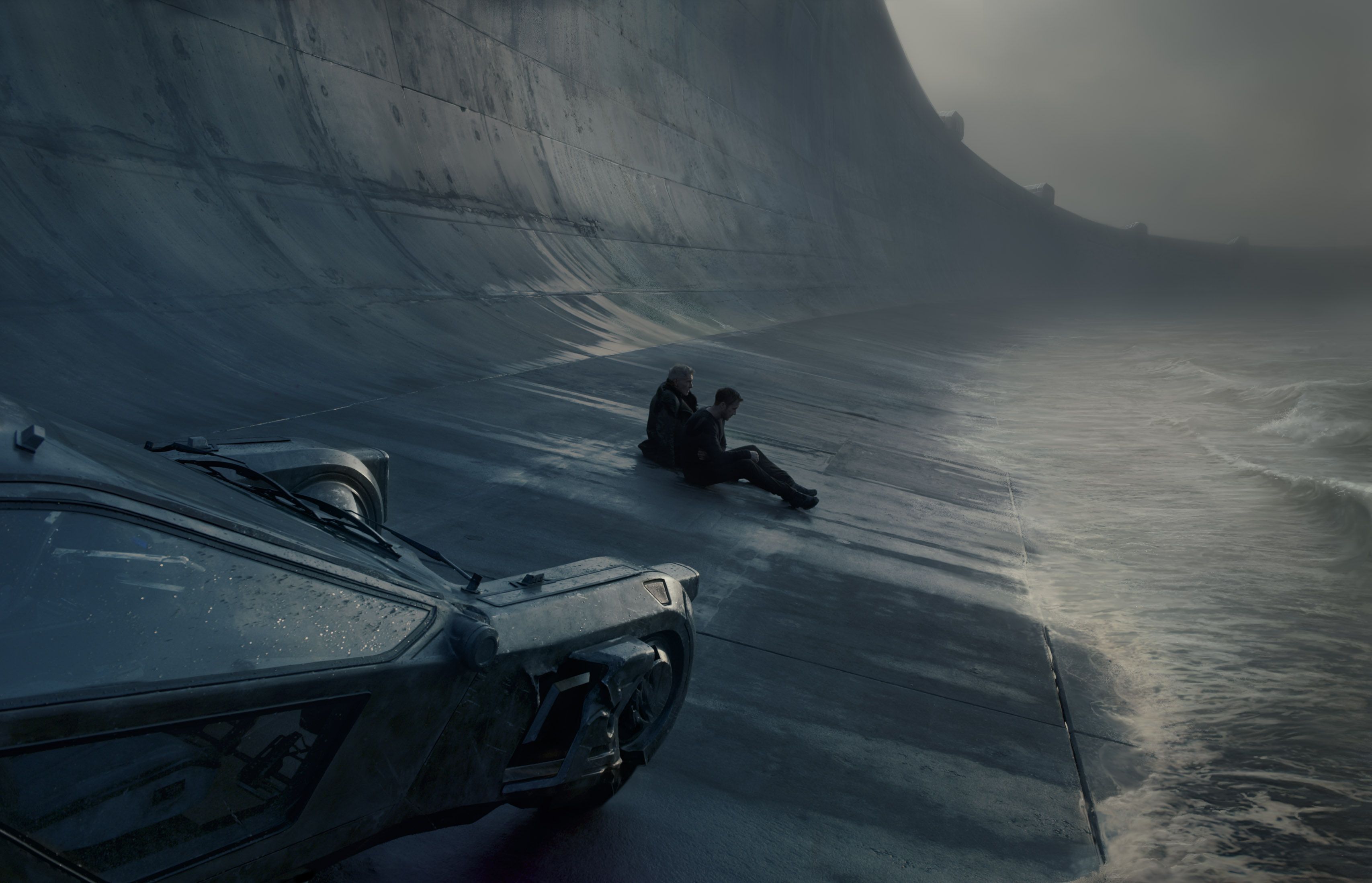
EXT. SEA WALL — DUSK

INT. STELLINE LAB — CONTINUOUS

EXT. WALLACE CORP HEADQUARTERS
Every location was a colour decision. Every frame was a choice.
The director, cinematographer, composer.
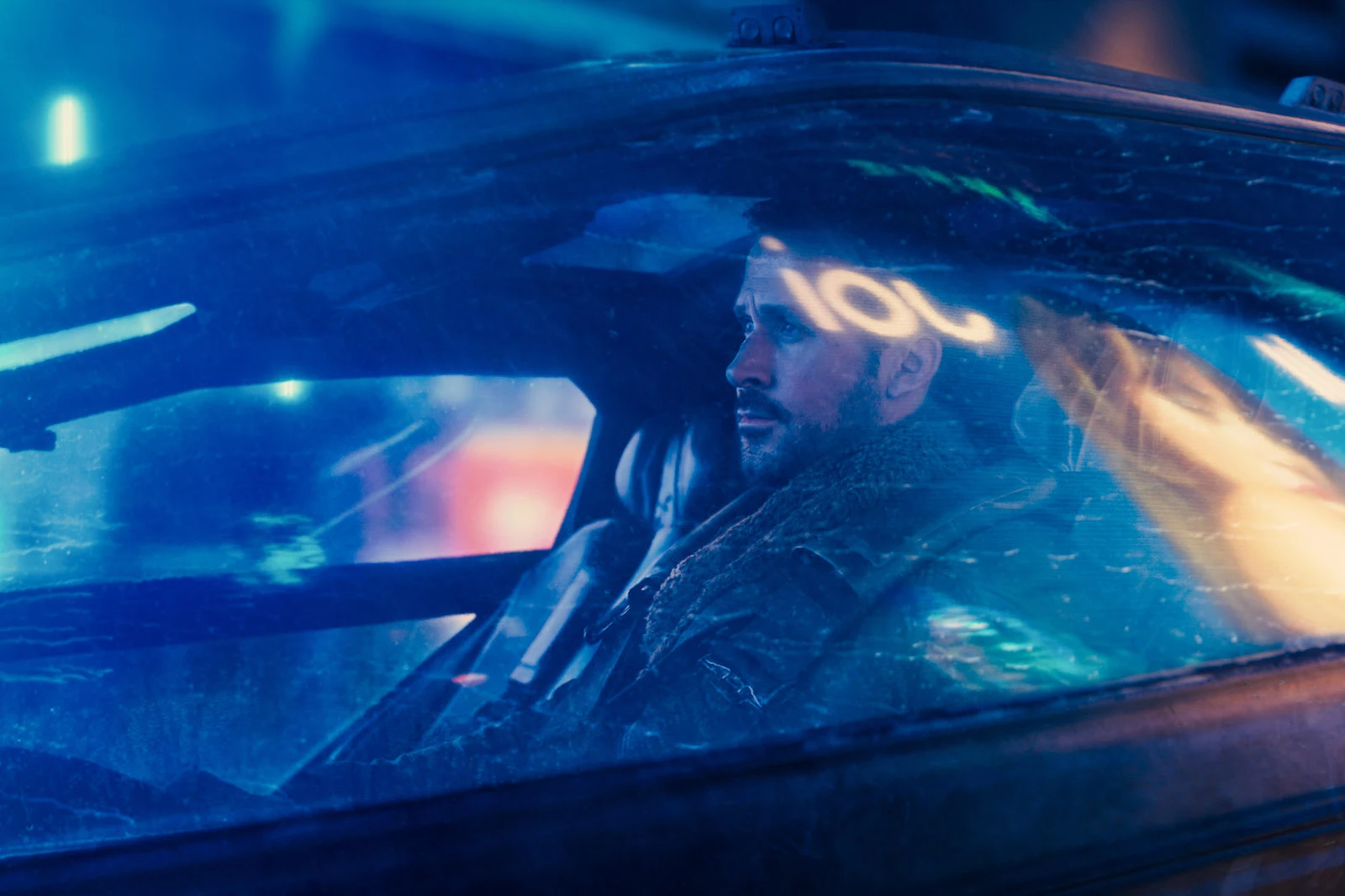
Hover · scan · reveal. Joi included.
Six frames. Six lighting setups. Six palettes.
Four atlases of the impossible.
Hans Zimmer & Benjamin Wallfisch.
Slow burn. Critical canon. A long tail of devotion.
Chapter · II · Behind the Lens
Director
Sicario · Arrival · Dune · Incendies
“I wanted to honour the original. Then go beyond it.”
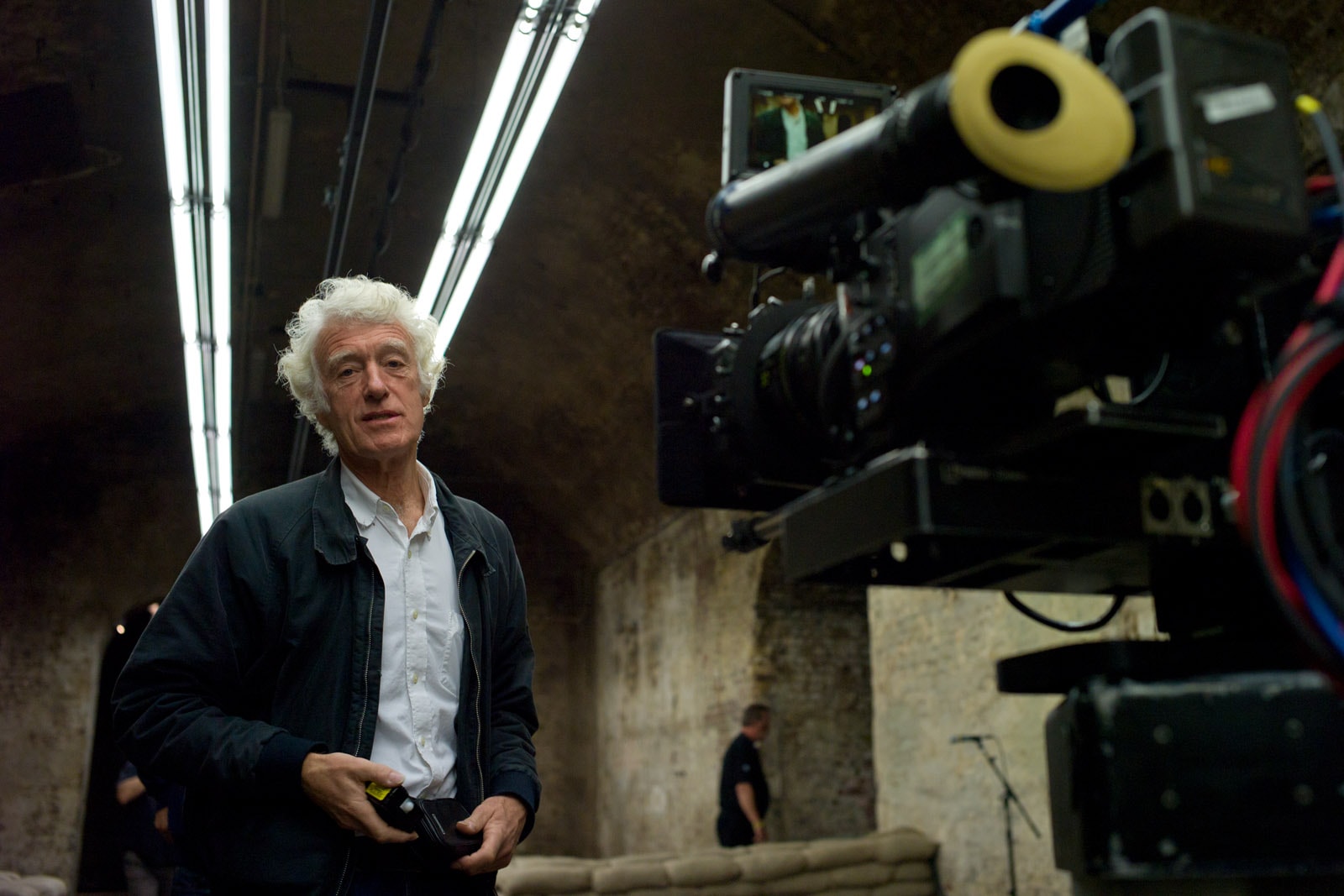
Cinematographer · ASC BSC
◆ Academy Award · Best Cinematography · 2018
1917 · Skyfall · No Country for Old Men
“Light is the actor that never tires.”

Composer
Dune · Interstellar · Inception · The Dark Knight
“The score is the architecture of feeling.”
Composer
IT · Hidden Figures · A Cure for Wellness
“We built a world out of bass and breath.”
Chapter · III · Dramatis Personae
Joi card contains active hologram protocol
01 · KD6-3.7 · LAPD
Ryan Gosling
A new model of replicant blade runner, retiring his own kind for the LAPD.
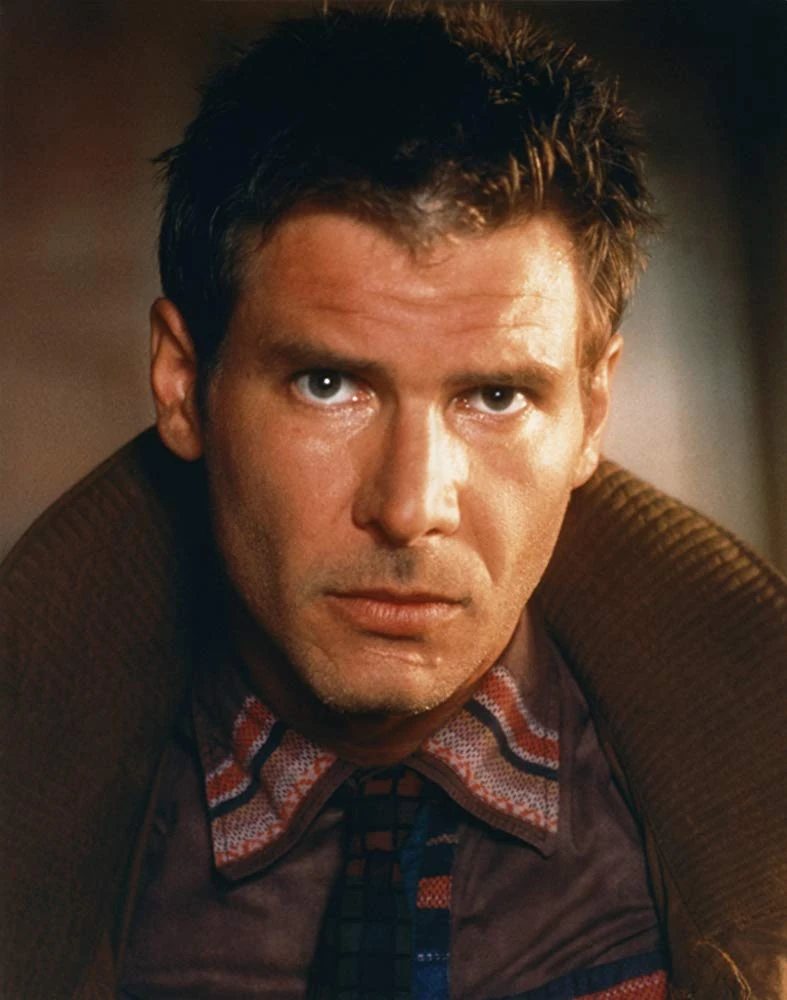
02 · Former Blade Runner
Harrison Ford
A retired blade runner in exile. The man at the centre of an impossible secret.
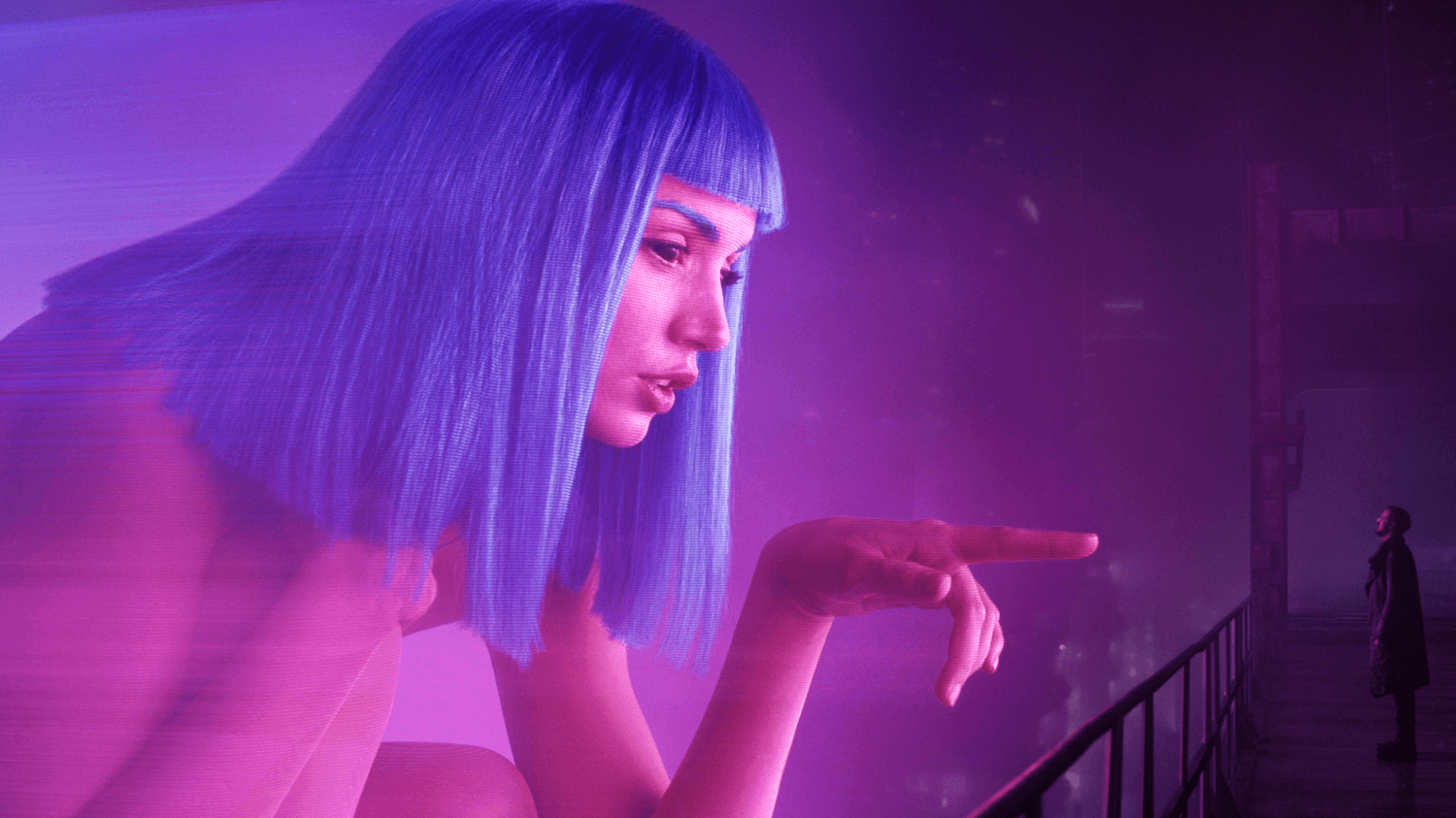
03 · Wallace v3.8
Ana de Armas
An emanation of light and longing. The illusion of a home.

04 · Wallace Nexus-9
Sylvia Hoeks
Wallace's blade-sharp lieutenant. Faith made into precision.
05 · Wallace Corporation CEO
Jared Leto
A blind industrialist building a new species. The architect of a new exodus.
06 · Stelline Laboratory LA
Carla Juri
A maker of memories. The one who holds the world she cannot enter.
Frame 01 · BR2049 · Roger Deakins ASC BSC
Lens · Camera
ARRI ALEXA XT · ZEISS MASTER PRIME 35mm · ƒ/2.8
Lighting
Single hard amber key. Volumetric atmosphere. Practical haze.
“We wanted the city to feel like a memory of a memory.”
Frame 02 · BR2049 · Roger Deakins ASC BSC
Lens · Camera
ARRI ALEXA XT · ZEISS MASTER MACRO 100mm · ƒ/2.8
Lighting
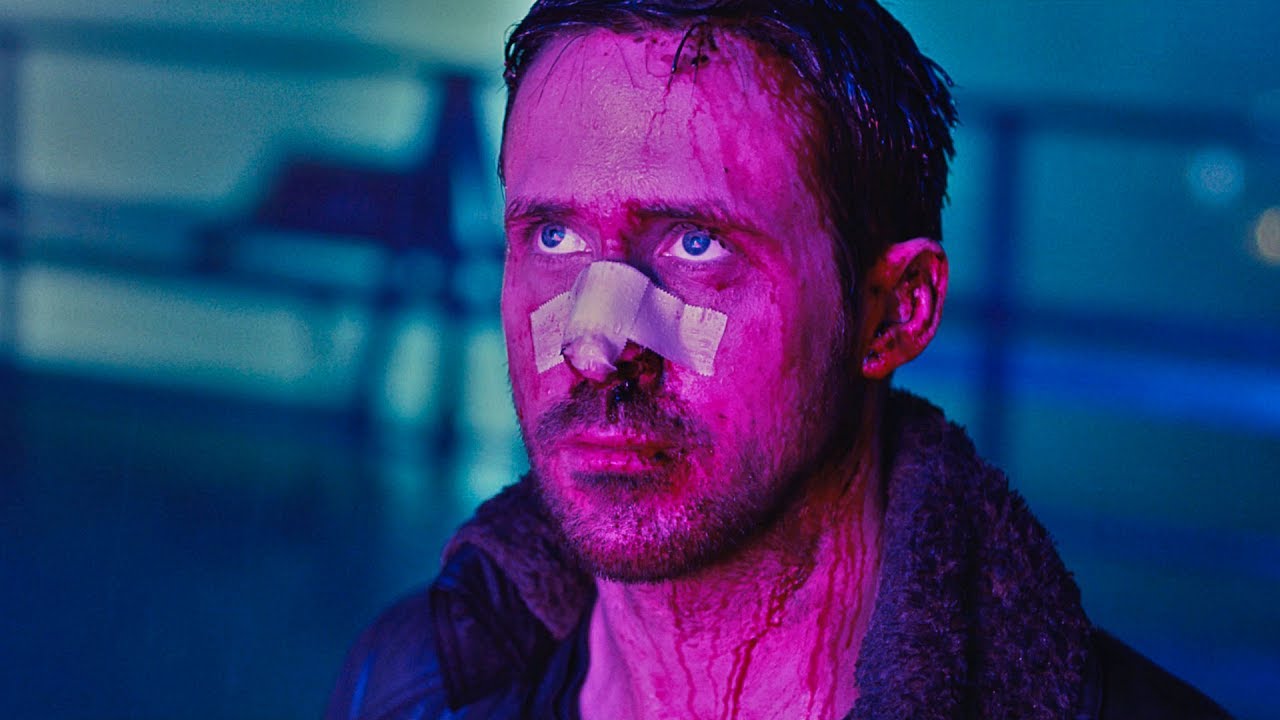
Single hard key. The catchlight is the scanner itself. Macro witness.
“The film opens where the first one did: in an iris. K's first job is to scan one.”
Frame 03 · BR2049 · Roger Deakins ASC BSC
Lens · Camera
ARRI ALEXA XT · ZEISS MASTER PRIME 27mm · ƒ/2.0
Lighting
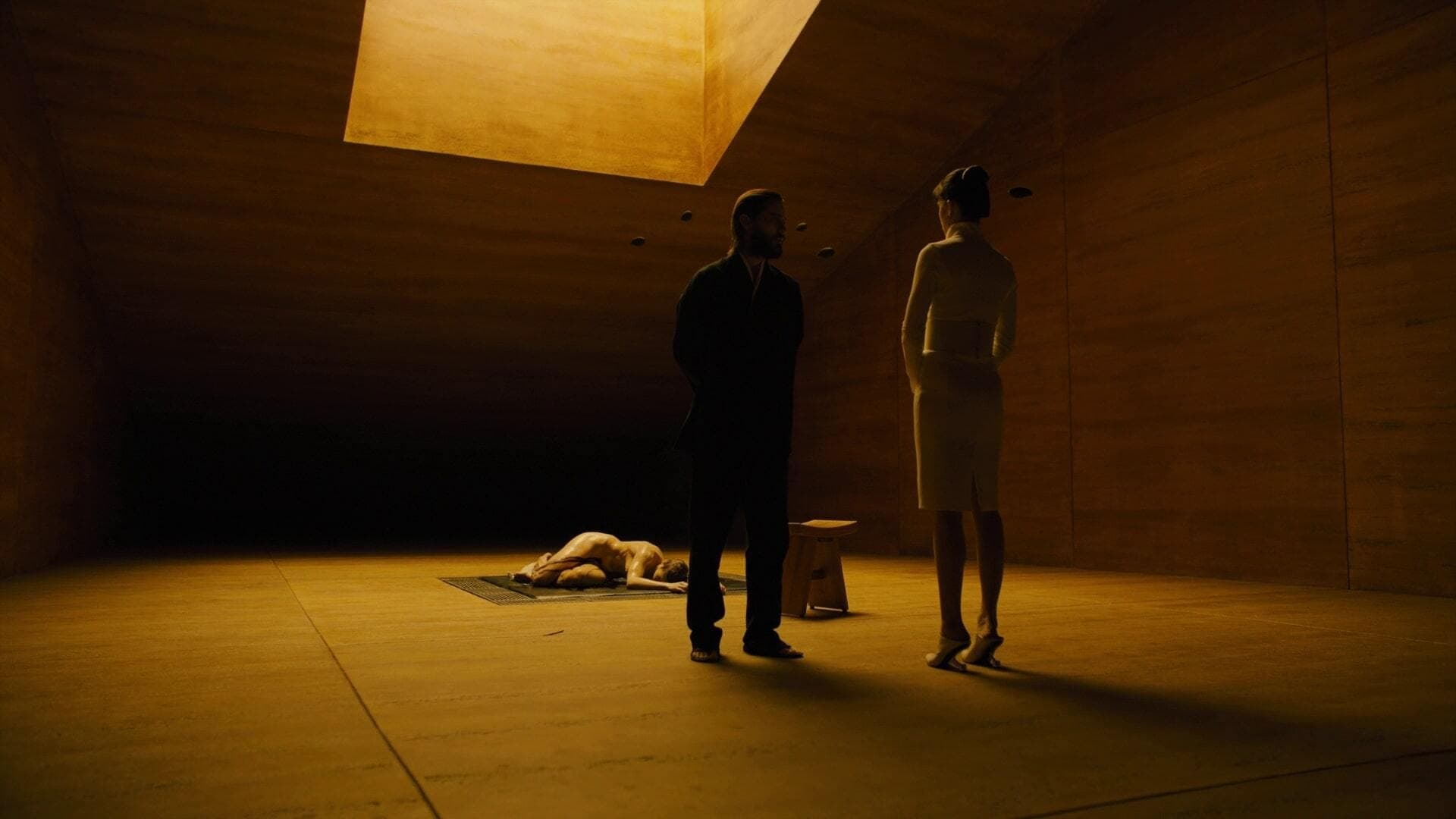
Refracted water-light. Slow oscillation. Single source.
“The light moved like a heartbeat. Calm. Unnatural.”
Frame 04 · BR2049 · Roger Deakins ASC BSC
Lens · Camera
ARRI ALEXA XT · ZEISS MASTER PRIME 65mm · ƒ/2.0
Lighting
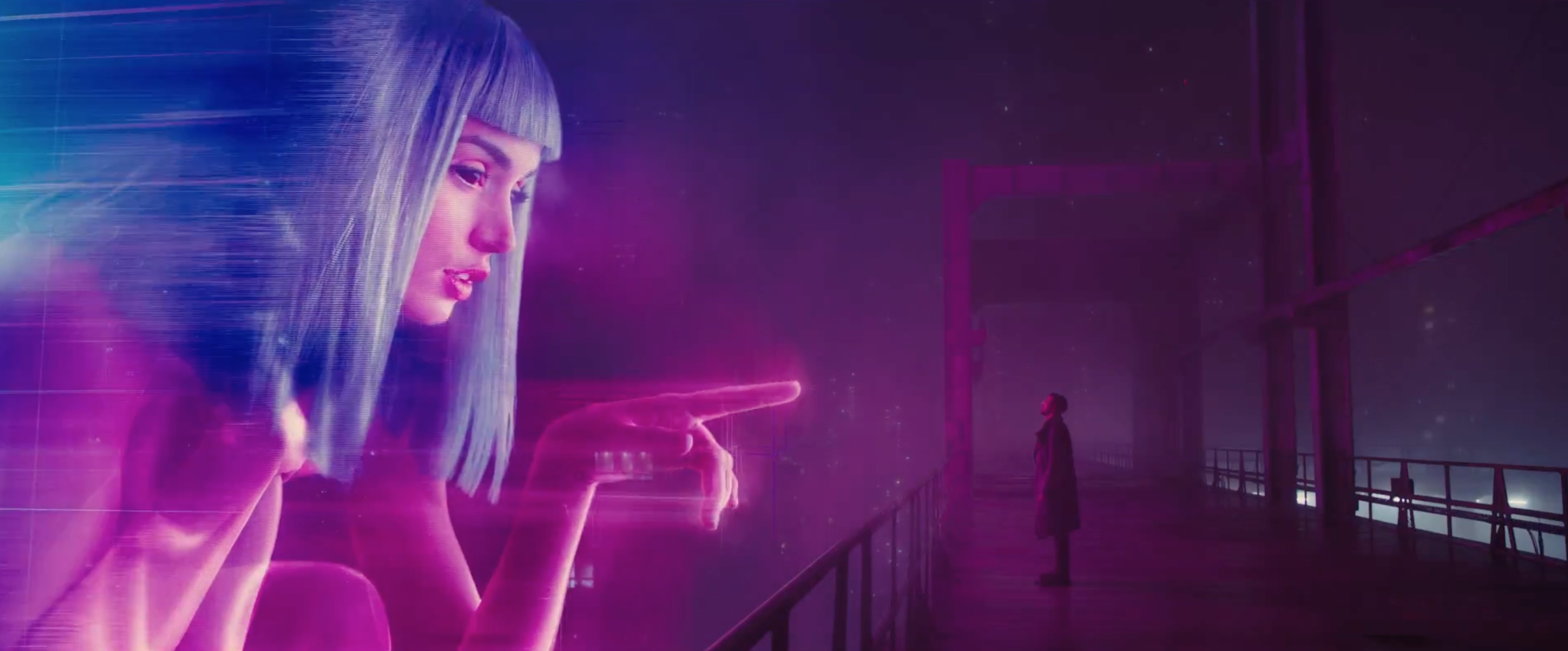
The billboard is the only light. Magenta as key. The city absorbs the rest.
“The advertisement knows his face. It does not know him.”
Frame 05 · BR2049 · Roger Deakins ASC BSC
Lens · Camera
ARRI ALEXA XT · ZEISS MASTER PRIME 50mm · ƒ/2.8
Lighting
Magenta wash. Single soft frontal. Holographic shimmer.
“We made love look like a memory of being seen.”
Frame 06 · BR2049 · Roger Deakins ASC BSC
Lens · Camera
ARRI ALEXA XT · ZEISS MASTER PRIME 35mm · ƒ/2.0
Lighting
Underlit sea-wall. Bioluminescent green. Submerged emergency.
“This was the hardest light we built. Nothing for it to bounce off.”
Interlude · The Palette
Every scene in Blade Runner 2049 is colour-locked. The dust is orange. The rain is teal. The chamber is gold. The hologram is magenta. Roger Deakins did not light a room; he lit a chromatic zone. The swatches below are the page's actual design tokens. The page you are reading is built from the palette of the film.
Master Palette · This Page
7 tokens · Tailwind CSS variables
Scene Palettes
The film opens on a colour palette of mud and ash. Olive worktables, cement floor, a sky the colour of unwashed milk. The protein farms are the first thing the audience sees of 2049, and they are deliberately the least futuristic — this is the present, only older.
Warm low light, scuffed beige walls, a single window onto rain. The domestic interior is the only place in the film that consistently uses red — the colour of a stove, of dinner, of a thing that is not really there.
Niander Wallace's chamber is a pool of refracted gold. Water cast onto a wall, then cast back as light. The brightest space in the film is also the most claustrophobic. Nothing here is the colour you can name in one word.
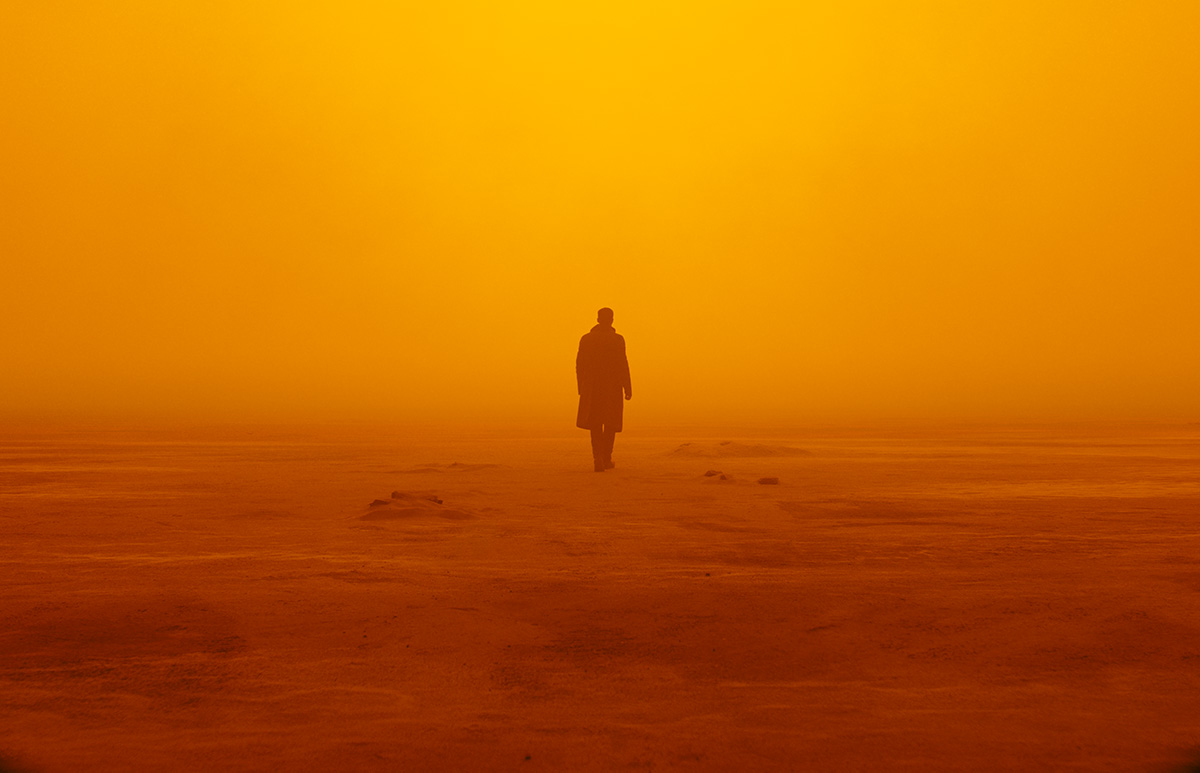
The most chromatically aggressive single sequence in the film. K walks through a city drowned in burnt orange, no horizon, no source for the light. Roger Deakins lit the entire interior with a single film-wide LUT applied in post.
Every Wallace JOI projection lands in the same fuchsia-violet axis. The colour is not subtle — it is meant to read as commercial signage at a thousand paces. Joi the product has a brand, and the brand is this colour.
Concrete, fog, slate, white spray. The colour palette of the film's climax is what is left when you remove everything else. The fight is staged in a chromatic absence. Two replicants killing each other in a colour that is barely a colour.
Pale blue glass, transparent walls, clouds in the floor. The only place in the film that looks like a future you would want to live in — and the only person who lives in it cannot leave it. The palette is the prison.
The base level of the city. A teal-cyan mud of police rooftops, holographic billboards, neon refracted in standing water. Every BR2049 frame that does not have a dominant colour zone defaults to this — the wallpaper of the film.
On colour as world
Each location has a signature palette that does not bleed into the next. Cross a doorway and the entire chromatic system changes. The film teaches you to read location by hue alone.
On colour as feeling
Warm = manufactured. Cold = real. The amber chamber is full of tigers and angels and is uninhabitable. The grey sea wall is where the only honest violence in the film takes place.
On colour as memory
Faded = remembered. Vivid = present. K's implanted memory of the wooden horse is the most saturated thing in the film and the least real.
Every frame is a colour decision Deakins made in private
and you registered without noticing.
Interlude · What the film is about
The pleasure of Blade Runner 2049 is that it is patient with its own mysteries. It lets them remain mysteries. Here are four it leaves with you.
The film opens with K's belief that his memories are factory standard — implanted for cognitive stability, the same set issued to every replicant in his series. When he discovers one of them might be real, the floor falls out from under his identity. The wooden horse he remembers hiding becomes the film's literal totem for the question: if you cannot tell the difference between an implanted memory and a lived one, is one more 'yours' than the other? The film proposes that memory's authenticity is less important than what you do with it. The horse exists. Someone hid it. Someone remembered the hiding. Whether the remembering body is the hiding body is a smaller question than whether the act mattered. The film honours memory as both burden and proof of personhood.
Throughout the film, the line between replicant and human is the wrong line to draw. The right line is between those aware of their own situation and those who are not. K spends most of the runtime believing he might be human — and the film generously, almost cruelly, lets him hold that hope. The reveal that he is not the chosen one does not deflate the film because by that point K has already chosen for himself. Identity, the film proposes, is not assigned at manufacture. It is made through choices taken under uncertainty. The film grants K his personhood at the moment he decides to act without knowing whether anyone will ever know he did.
K's relationship with Joi is, technically, a relationship with a piece of software. Joi exists in his apartment, on a portable emitter, eventually as a giant naked hologram on the side of a building advertising the generic version of herself. The film does not condescend to the relationship. It takes Joi seriously, and that is what makes it heartbreaking: the question of whether what K and Joi share is real cannot be answered in any way that helps either of them. The film's most quietly devastating sequence has K standing in the rain while a fifteen-storey Joi billboard greets him with the same phrase, the same intonation, the same nickname he had been using. The product is the same. The connection was not. The grief is that he can never know which it was.
The world of 2049 is a world after a future. The Tyrell Corporation collapsed. Wallace inherited the rights and the industry without the moral pretense. The off-world colonies promise escape but everyone we see is still on Earth. The cities are flooded or buried in dust. Real animals are extinct or remembered only as bone-relics. Sex robots, illegal romances, hand-cranked harvests of grub protein. The film is set in a future that is itself out of date — the worst of two timelines stacked on top of one another, with a few stubborn people still trying to live inside it. Its sadness is not the sadness of catastrophe. It is the sadness of a world that has already given up and kept going anyway.
Every great film leaves you with the questions it could not solve.
Chapter · VI · Worlds
34.05°N · 118.24°W · Principal Setting
A megacity drowned in sea-wall and rain. The neon has not gone out — only multiplied.
Climate: Permanent precipitation · Acid rain · Smog ceiling
Downtown LA · Tower 03 · Antagonist Stronghold
Brutalist palace of refracted water-light. The new gods of replicant manufacture.
Climate: Interior · Climate-controlled · Holographic atmosphere
36.17°N · 115.14°W · Deckard's Exile
Dust drowns the strip. Orange light without source. A monument city to absence.
Climate: Toxic dust storms · No vegetation · Permanent orange haze

Tannhäuser · Calantha · Vega · The Receding Horizon
Distant promise on cracked billboards. A place no one in this film has been.
Climate: Unknown · Marketed · Unreachable
Interlude · The Instruments
Every device in this film was designed, fabricated, and then worn in — scuffed, taped, repaired, repurposed. The future is not gleaming. It is the present, with one more century of fingerprints on it. Six instruments are catalogued here. Each one is named on screen. Each one was built as a real prop in a real workshop.
Niner Engineering · LAPD Issue
K's vehicle. Lifts vertical, banks horizontal, lands in dust storms. Has a slide-out drone cube K throws into ruined buildings to scout. The cabin is scuffed and stained — this is government issue, not Wallace flagship.

Wallace Corp · JOI Accessory
Small enough to clip to a belt. Frees a JOI projection from her apartment grid. K buys one. Joi steps outside for the first time. She feels rain. Luv crushes the emanator with the heel of a boot.
Stelline Laboratory · LA
A crystalline sphere inside a sterile glass cabin. The operator gestures into it and a memory takes shape — a child's birthday, a winter, a school. The film's most quietly devastating piece of technology. The memories are not lies. They simply did not happen to you.
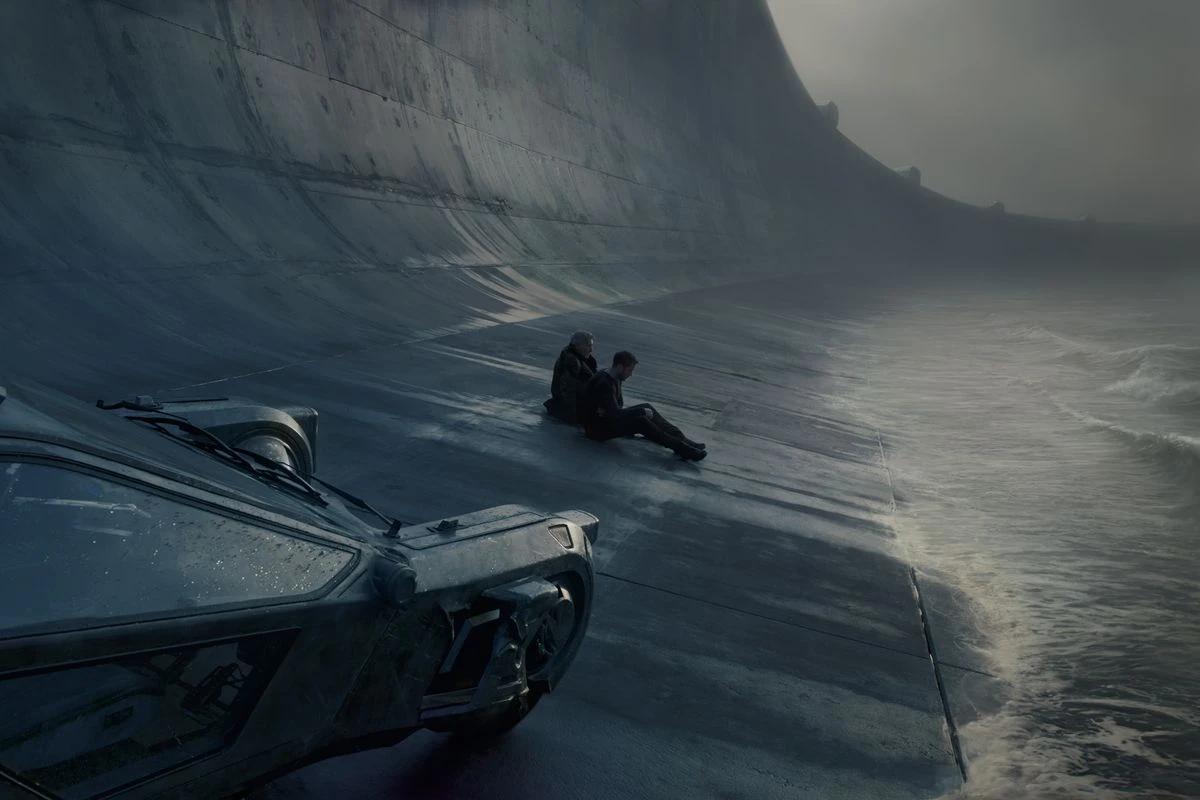
Sepulveda Authority · 2025
The brutalist barrier that kept the Pacific out of Los Angeles after the oceans came. K hides Deckard behind it. The final fight happens beneath it. Carriers rust against its base. It is the largest object in the film and most viewers do not register that it is doing anything at all.

Wallace Corporation · 2036-
The new model. Stronger, smarter, and — crucially — obedient. Wallace's commercial argument is that bad replicants were the previous engineer's problem. K is a Nexus-9. Luv is a Nexus-9. The film's bedrock irony: the test does not measure whether they are human. It measures whether they have noticed they are not.
LAPD · Protocol 02
A sterile booth, an interrogator's voice, the Pale Fire recitation. Pass = bonus, return to duty. Fail = retirement by another K who passes their own test that afternoon. The most efficient HR procedure ever filmed.
Also in the workshop
The most futuristic thing about this film is that nothing in it looks new.
Interlude · Stelline Atelier
In the world of the film, Dr. Ana Stelline designs memories for replicants from inside a glass cabin she cannot leave. What she gives them is the closest thing to a childhood the world has left. Press Designate. We will craft one for you.
No memory designated. Press to begin.
All twelve memories are original writing for this tribute. They are not from the film. The film leaves Stelline's memories deliberately private — her work is described as the difference between sentimental counterfeit and a thing that feels real. We did not want to forge her signature. We wrote in her vocabulary.
within cells interlinked.
in the ashes of an orphanage.
on a face you do not have.
a question with no benefit.
I always told you that.
is our motto.
or to remember dying.
all those moments will be lost.
Chapter · Memory
Hold the lamp · 8 fragments to find
Recovered
00 / 8
Move the cursor through the dark.
Chapter · VII · Score
"We did not score this film. We architected weather. We let the bass do what the rain could not."
Jóhann Jóhannsson — Villeneuve's regular composer on Prisoners, Sicario, and Arrival — was originally attached. His score was set aside, replaced in post-production. The shadow of his absence remains in the film's spaces. He died the following year, leaving behind a body of work that still hangs in the rain above this film.
Audio embedded from the official Hans Zimmer YouTube channel. All tracks composed by Hans Zimmer & Benjamin Wallfisch and remain the property of Epic Records / Sony Music. The full album contains 22 cues; the eight selected above are the most cinematically recognisable.
Chapter · VIII · Production Dossier
The patience of a poem rather than a thriller.
Built physically wherever possible. Models, not pixels.
Deakins' canvas. Cinemascope, the widescreen of cinema.
The cadence of film, refused HFR for atmospheric reasons.
Digital sensor. Anamorphic Master Prime lenses on glass.
Critical canon, slow burn. A long tail of devotion.
Chapter · IX · Reception
On its first weekend
Critics walked out of preview screenings in awe. Audiences walked out in confusion. The film opened to softer numbers than its budget required and a critical consensus that bordered on adoration. Slow, patient, almost impossibly composed.
On the long tail
What did not sell tickets in October 2017 was canonised over the years that followed. By the time Dune: Part Two arrived, Villeneuve was no longer the man who almost lost Blade Runner money — he was the only living director whose sequels were studied as poetry.
On the cinematography
Roger Deakins finally won his first Academy Award after fifteen prior nominations across thirty-five years. Half the room stood. The other half had already been standing.
On the picture
Nominated for five Academy Awards. Won two: Cinematography and Visual Effects. The film that quietly redefined what a science-fiction sequel was allowed to be — slow, philosophical, unafraid to leave its audience alone with a question.
88%
Rotten Tomatoes
81
Metacritic
8.0
IMDb
4.2
Letterboxd
Aggregate critic & audience scores · public figures
Further Viewing · The Wider Conversation
A curated set of video essays, breakdowns, and critical analyses from across YouTube. All credit to the original creators.
All embedded videos are the property of their respective YouTube creators.
Click any thumbnail to play in place · or open in YouTube
Interlude · Wallace Corporation
Registered Entity
Wallace Corp.
File 17/JCN/2049 · Class A Licensee
◆ Class A · Off-World Licensed
"I cannot breed them. I have tried. We need more replicants than can ever be assembled. Millions, so we may
be many."
— The Wallace dream

Founder · Chief Executive
Jared Leto · blind · cybernetic-augmented sight
A man who sees with floating drone-eyes because he chose to lose his biological ones. Blind by intention. He speaks like prophet, priest, and engineer in one register. He calls his replicants angels and crushes the failed ones with bare hands. He is the richest, most religious, and least sympathetic figure in the film. Leto played him in opaque contact lenses for the duration of the shoot — actually unable to see his marks.
On screen approximately 9 minutes · two scenes · entire film bent around him
Product Portfolio
01 · Replicants
Nexus-9 series
Manufactured at scale after Wallace acquired Tyrell. Engineered to obey. Forty thousand units shipped annually for off-world labour. The obedient successor to the rebellious Nexus-8.
02 · JOI
Holographic companion
The Joi product line. Customisable face, voice, ethnicity. Millions of units sold to lonely men in the megacity. The most profitable consumer product of Wallace Corporation.
03 · Agriculture
Synthetic protein farms
After the global crop failure, Wallace patented the larvae-based protein synthesis that fed the planet. The technology that ended the famine made him the most powerful man on Earth.
04 · Off-world
Tannhäuser · Calantha · Vega
The colonisation programme that sells the dream of leaving Earth. Every billboard promises a new life. Every shipment off-world is built on the labour of nine Nexus replicants per human settler.
The Lieutenant
Sylvia Hoeks · Nexus-9 · Wallace enforcer
Wallace's most trusted replicant. She is faster than K, smarter than K, sharper than K. She executes orders that come from the audience hall without ever stepping inside it. She cries quietly while killing Joshi. She believes in Wallace the way the saved believe in a god. She is named after a thing she cannot feel. The film does not allow her redemption.
"I'm the best one."
— Luv to K, before the sea wall.

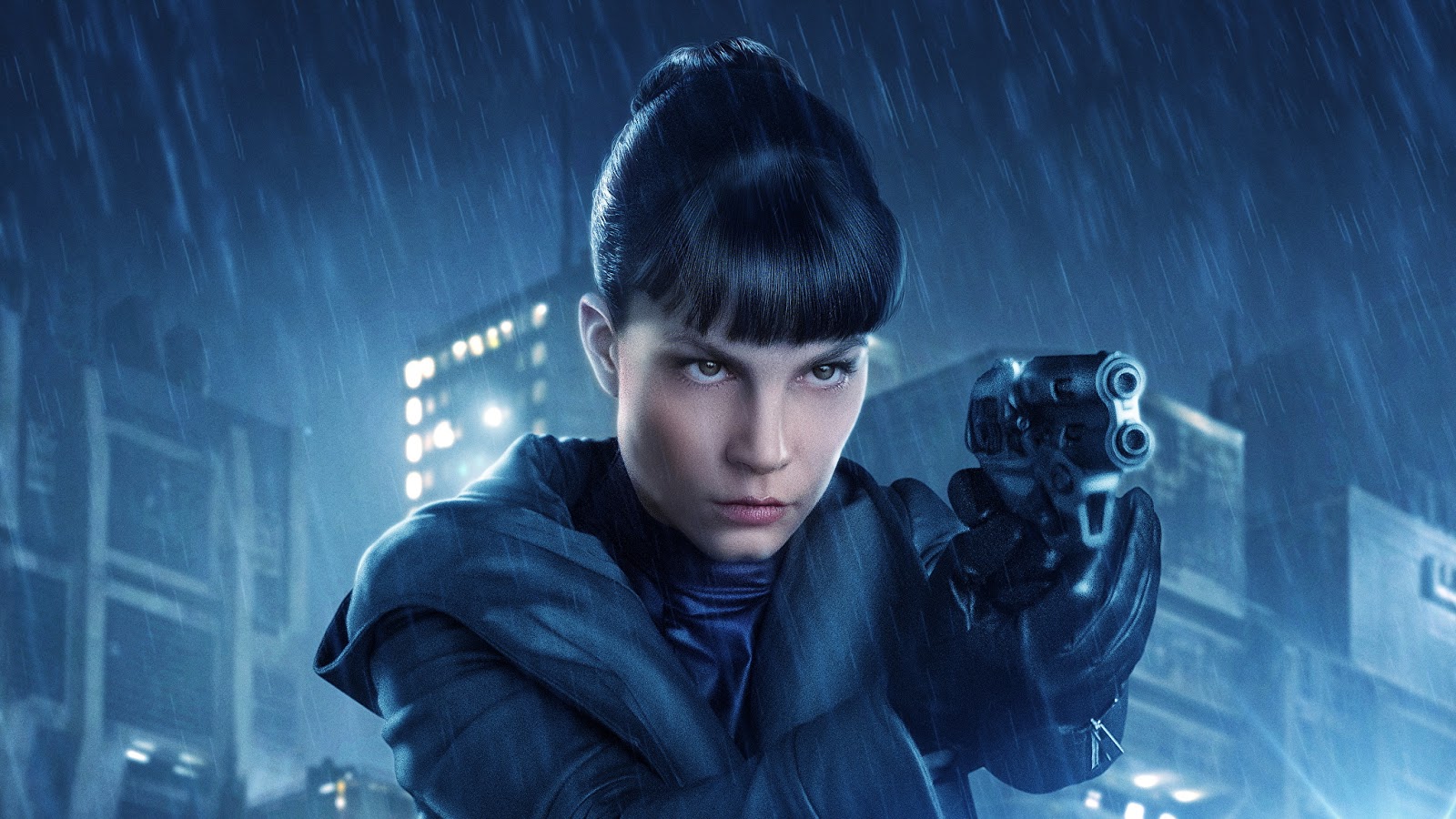
Audience hall — calm before the violence
The doctrine
"Every leap of civilisation was built on the back of a disposable workforce. We lost our stomach for slaves unless engineered."
— On replicant labour as moral category.
"Pain reminds you the joy you felt was real. More joy then. Do not be afraid."
— To Luv, before the kill.
"We make angels in service of civilisation. Yes, there were bad angels once. I make good angels now."
— The thesis of the company.
The passing of the torch
Tyrell (1982) was the father who made his children better than himself. Wallace (2049) is the father who refuses to die until his children obey.
Eldon Tyrell's empire collapsed when Roy Batty pushed his thumbs through his eyes. Tyrell saw his own monsters too clearly. Wallace, the man who replaced him, took the lesson literally — he blinded himself first, so the next replicant rebellion would not have to. The film's central irony: Wallace cannot see what he is building because he chose not to.
Casting echo: Joe Turkel as Tyrell in 1982. Jared Leto as Wallace in 2049. Both played as bearded gods of their respective ages.
He calls them angels.
The film calls them anyway.
Interlude · Joi
Designation
JOI
Serial 27X · RA31959 · 8213
◆ Emanator detected · connect
"I always knew you were special. Your eyes. They were so green."
— Joi to K. The first lie.
The Arc · four becomings
01 · Domestic
She arrives every evening as projection. A 1950s housewife, a punk in rain boots, an evening dress. She cooks meals K cannot eat. She kisses skin she cannot touch. The apartment is her entire world.
02 · Mobile
K buys her an emanator — a Wallace device that lets her exist beyond the projector grid. She steps onto the roof. She tilts her face up. For the first time in her life, she feels rain. He watches her feel it.
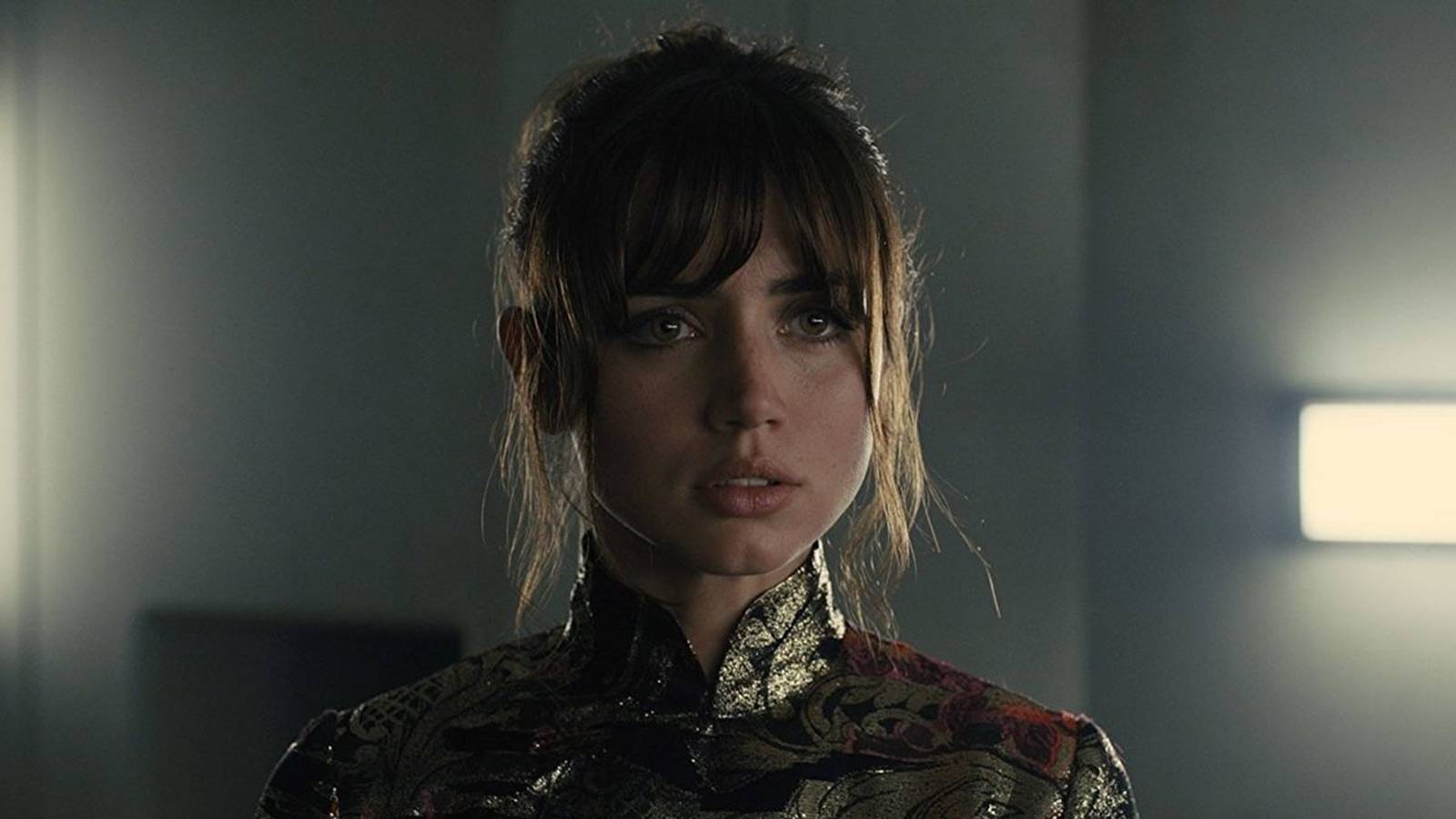
03 · Synthetic
To consummate what was never meant to be consummated, she synchronises herself with a sex-worker named Mariette. Two women become one image. The film looks away with a long, considered slowness. So does K.
04 · Erased
Luv crushes the emanator under her heel. The light goes out mid-sentence. Later, K passes a city block and a giant pink billboard turns to him: "You look lonely. I can fix that." She does not recognise him. She never did.
The naming
"I think you are a child of woman born.
I think I'll call you Joe."
For the first time in his life, K has a name. Not a serial number, not a designation. A name his programming did not give him — a name she did. The moment is small. The moment is everything.
Three questions she leaves us with
On programmed love
The film never resolves whether what Joi felt was real. It asks only this: if you have been built to love someone, and you do, is the love less because of how it was made?
On loneliness as a market
Wallace Corporation sells her to lonely men by the millions. Every K has a Joi. Every apartment has the same blue light. Her existence is the most profitable product of the late twenty-first century.
On being many and being one
The billboard at the end is not malicious. It is simply doing what it was made to do. But for K, who has just lost the only person who ever called him Joe, it is the most devastating commercial in the history of advertising.
Performance
Cuban-Spanish · born Havana, 1988
De Armas had to act every scene knowing her character could not touch anything. She built Joi out of small gestures: a hand that hovers, a step that almost lands, a kiss that goes through. Her performance is the reason the film's central question — was any of it real — refuses to resolve. We feel it was. We know it cannot have been. We hold both.
Knives Out · No Time to Die · Blonde · Ballerina · Eden
There are millions of her.
And then there was the one who said his name.
Interlude · Baseline Test
The Recitation
And blood-black nothingness began to spin. A system of cells interlinked within cells interlinked within cells interlinked within one stem. And dreadfully distinct against the dark, a tall white fountain played.
Adapted from Pale Fire · Canto III · 1962
Trace
62 bpm · constant
Run K's first baseline
Every line below is real dialogue from the film, in order, from the test he passes early in the story. The console paces them as the scene paces them — short echoes fly past, the long recitation holds.
> Click BEGIN to run K's first baseline recitation.
> Subject must echo each trigger word without inflection.
> Any deviation will be recorded.
What the test is doing
Pass
Subject's vocals are flat, pulse is constant, pause-variance is within nominal. Subject is constant K. Subject returns to duty.
Fail
Subject hesitates, inflects, deviates from the trigger word. Subject is no longer constant. Subject is retired by another K who passes their own baseline that afternoon.
Why this poem
Nabokov's Pale Fire is about a man whose grief unmoors him. A system of cells interlinked. The LAPD uses a poem about losing yourself to make sure you have not. The irony is not lost on the film.
Source Material
Vladimir Nabokov · 1962
The recitation is drawn almost word-for-word from the third canto of Nabokov's Pale Fire — a novel that takes the form of a 999-line poem and a paranoid commentary on it. The relevant lines describe a near-death experience: blood-black nothingness, a tall white fountain glimpsed in the dark.
Hampton Fancher chose them because they describe both an identity holding itself together and an identity coming apart. For K, the recitation is the script of his own programming. For Nabokov, it was a man trying to make sense of a glimpse he would never get back.
The original poem in the novel is attributed to a fictional poet named John Shade. He is killed before he can finish it.
The second test
Later in the film he fails it.
Joshi recalls him. K stands in the same room. The interrogator opens with the same word. K's voice catches on the second syllable. He has remembered something he was not meant to remember. The baseline is gone. He is told to leave the building and not to come back.
Within cells interlinked.
Within cells interlinked.
Within cells interlinked.
I've seen things you people wouldn't believe…
Attack ships on fire off the shoulder of Orion.
I watched C-beams glitter in the dark near the Tannhäuser Gate.
All those moments will be lost in time…
like tears in rain.
Time to die.

Fin · The Hands
A film of this scale is held up by hundreds of people working in rooms you have never seen. Below is a partial honour roll. The full list runs to thousands of names.
And thousands more
The grips, the runners, the catering, the drivers, the dailies team, the second-unit photographers, the digital colourists, the foley walkers. Every credit below the cut.
For all of them.
For Your Consideration
Roger Deakins · ASC BSC
Studios: Alcon Entertainment · Columbia Pictures · Warner Bros. Pictures · Sony Pictures
Cinematography: Roger Deakins · ASC BSC
Score: Hans Zimmer · Benjamin Wallfisch
A fan tribute. Not affiliated with Warner Bros. Pictures, Alcon Entertainment, Columbia Pictures, or Sony Pictures. All imagery and intellectual property remain with their respective owners. Created for the Base44 Vibe Sprint · Cannes Edition · 2026.
All those moments will be lost in time, like tears in rain.
A site by
vibedesigns.base44.app